


What is argon and where is it used? Purity grades and safety
Argon’s properties, how it is produced, what purity grades from 4.6 to 6.0 mean, applications from welding to electronics, and the risk it carries as an asphyxiant.
3 min read
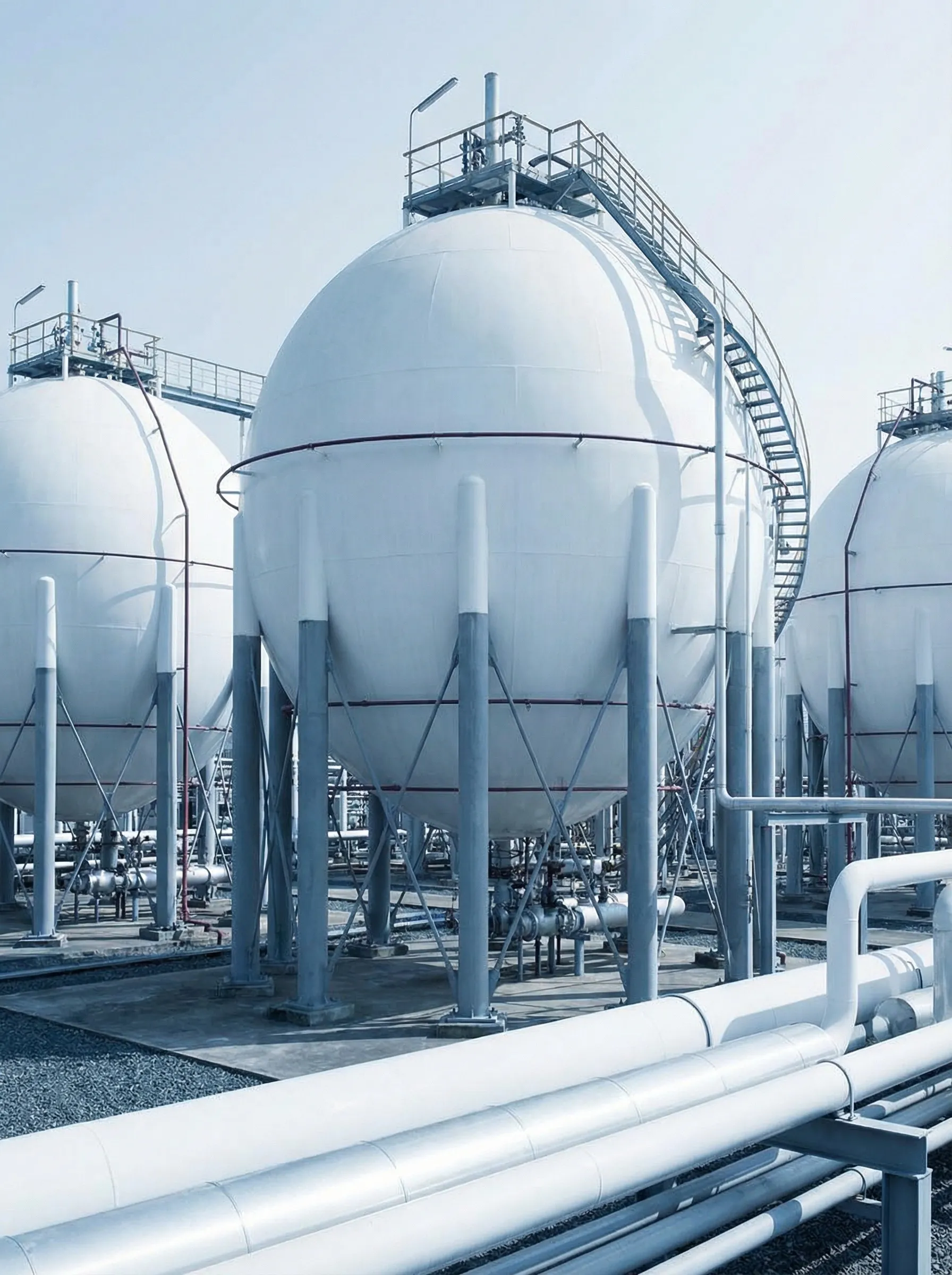
Argon is the most widely used inert gas in industry. Colourless, odourless and unreactive, it appears almost anywhere hot metal has to be kept away from air. From the welding shop to the semiconductor fab it performs the same job: making the environment chemically quiet.
Basic properties
| Property | Value |
|---|---|
| Symbol / atomic number | Ar / 18 |
| Group | Noble (inert) gas |
| Share of the atmosphere | ~0.93% — the third most abundant after nitrogen and oxygen |
| Appearance and odour | Colourless, odourless, tasteless |
| Density vs air | About 38% heavier than air |
| Chemical behaviour | Does not react under normal conditions |
Being heavier than air is its most safety-critical property; we return to this in the safety section below.
How it is produced
Argon is obtained by cryogenic separation of air. Air is cooled to liquefaction and its components are separated in distillation columns according to differences in boiling point. Because argon boils between nitrogen and oxygen, it is drawn off the column as an intermediate product and then purified to the required grade.
Purity grades: what 4.6, 5.0 and 6.0 mean
Gas purity is usually written as a two-digit code. The first digit gives the number of nines in the percentage and the digit after the point gives the final figure:
| Grade | Purity | Typical use |
|---|---|---|
| 4.6 | 99.996% | Welding and general industrial use |
| 5.0 | 99.999% | Precision welding, analytical instruments, heat treatment |
| 6.0 | 99.9999% | Semiconductors, high-precision analysis and laboratories |
Our guide holds the data sheets for Pure Argon, 60 Grade Argon and High Purity Argon 99.999%.
Applications
- Welding. Pure argon as the shielding gas in TIG welding; the main component of mixtures in MIG/MAG welding. See the Corgon and Varigon data sheets for mixtures.
- Metallurgy. Argon is injected into the melt in steelmaking for stirring and degassing, and used as a protective atmosphere in heat treatment.
- Electronics and semiconductors. Provides an inert environment in crystal growing and sputter coating.
- Analytical laboratories. Used as plasma and carrier gas in instruments such as ICP.
- Lighting and glass. Lamp filling, and the cavity of insulating glass to improve thermal performance.
- Food and beverage. As a blanketing gas over oxygen-sensitive products.
Safety: not toxic, but an asphyxiant
Argon is not toxic; the risk comes from it displacing oxygen. Being odourless and colourless, a leak goes unnoticed, and being heavier than air it accumulates in pits, trenches and at floor level.
- Carry out oxygen measurement when working in confined or low-lying spaces, and use a personal O₂ detector.
- Plan ventilation from floor level; ceiling extraction is not sufficient for argon.
- Never enter to recover an unconscious person without respiratory protection; rescuers becoming the second casualty is a typical scenario with these gases.
- Store cylinders upright and secured in a ventilated area. See our cylinder safety article for the details.
Supply formats
Argon can be supplied as single cylinders, in manifold bundles or as bulk liquid. The right format depends on your monthly consumption and the layout of your point of use. Share your consumption and purity requirement and we will build a supply plan together. Start by reviewing our industrial gases family.
More technical articles
-
Choosing a shielding gas for MAG welding: what the CO₂ ratio changes
The CO₂ ratio in an argon–carbon dioxide mixture directly changes penetration, spatter and bead appearance. Here is how DIN EN ISO 14175 classes work and which mixture suits which job.
-
Modified atmosphere packaging (MAP): how gas extends shelf life
What nitrogen, carbon dioxide and oxygen do inside the pack, typical atmospheres by product group, and what “food grade gas” actually means.
-
Gas cylinder colour codes and safe handling: an EN 1089-3 guide
What the shoulder colour tells you, which gas carries which colour, and the rules that apply in storage. EN 1089-3 colour coding plus practical safety notes.