


Shielding gas for TIG welding: argon, helium and hydrogen mixtures
Why oxidising gases cannot be used in TIG, what helium and hydrogen additions change, and how root shielding works. Gas selection by material.
3 min read
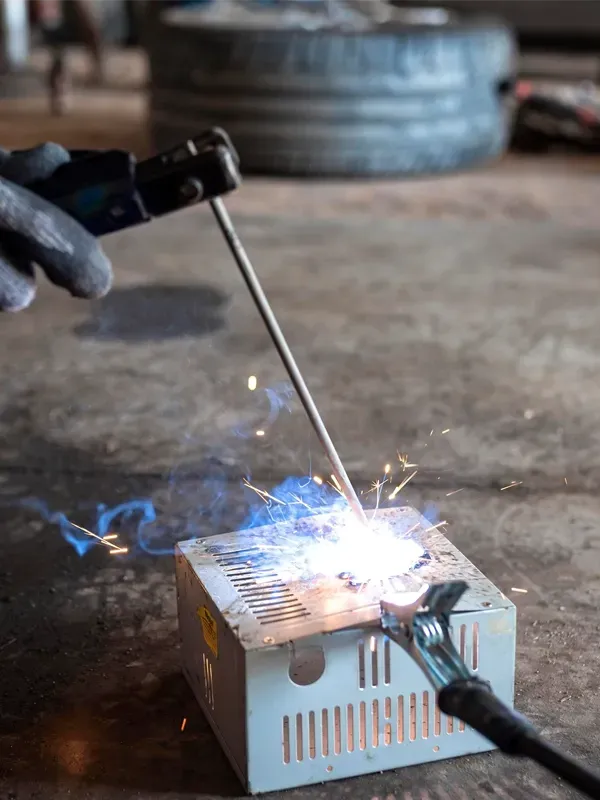
TIG welding (GTAW) works with a non-consumable tungsten electrode. That single sentence also explains why shielding gas selection differs completely from MAG: because the electrode is not a consumable, the gas must be inert.
Pure argon: the default choice
Pure argon is the base gas of TIG welding. Its low ionisation energy makes the arc easy to strike and stable even at low currents, and being heavier than air it stays over the pool, giving good protection at low flow. It is the first choice on almost every material, including steel, stainless, aluminium and copper.
The limit of pure argon is heat input: it struggles to open the pool on thick sections and on materials that conduct heat away quickly, such as aluminium and copper. That is where mixtures come in.
Argon–helium: more heat, faster welding
Helium raises the arc voltage, delivering higher heat input at the same current. The result is wider, deeper penetration and higher travel speed. Varigon He25 (75% argon + 25% helium) is the typical member of this family and falls under group I3 (ArHe) in DIN EN ISO 14175.
- Where it helps: thick aluminium and copper, production work needing high travel speed, automated and robotic TIG.
- The cost: helium is lighter than air and escapes, so the flow needed for the same protection is noticeably higher than with pure argon.
- Watch out: arc striking is harder than with pure argon; at high helium contents the ignition settings should be reviewed.
Argon–hydrogen: clean, fast welds on stainless
Hydrogen both increases thermal conductivity and acts as a reducing agent: it prevents oxidation, leaves a bright, clean surface and raises welding speed. Varigon H5 (95% argon + 5% hydrogen) is classified as R1-ArH-5 in the standard.
MAG on stainless: the Cronigon family
If you weld stainless with MAG rather than TIG, carbon-steel mixtures are unsuitable: high carbon dioxide affects the chromium content of the bead and reduces corrosion resistance. Argon-based mixtures with very low CO₂, such as Cronigon 2, are developed for this.
Do not forget root shielding (purging)
When welding stainless pipe and tanks, the back of the weld must be protected too. An unshielded root oxidises and leaves a porous, granular surface, losing both corrosion resistance and appearance. Argon or nitrogen-based mixtures are used for purging, and the oxygen level in the zone is measured before starting.
Application settings
| Topic | Practical value | Why |
|---|---|---|
| Flow rate | Generally 6–12 l/min with argon | Varies with torch, nozzle diameter and position; excess creates turbulence |
| Post-flow | Roughly 1 second per 10 A | The cooling tungsten and weld are still open to oxidation |
| Gas lens nozzle | For precision and visible welds | Smooths the flow: wider coverage, less turbulence |
| Tungsten stick-out | Limited by nozzle diameter | Excessive stick-out sits outside the gas shield |
In short
The gas in TIG must always be inert. Pure argon covers most work; a helium addition helps on thick aluminium and copper, and a hydrogen addition brings speed and quality on austenitic stainless. Share your material and thickness and we will determine the right mixture together — start with our welding gases family.
More technical articles
-
Choosing a shielding gas for MAG welding: what the CO₂ ratio changes
The CO₂ ratio in an argon–carbon dioxide mixture directly changes penetration, spatter and bead appearance. Here is how DIN EN ISO 14175 classes work and which mixture suits which job.
-
Modified atmosphere packaging (MAP): how gas extends shelf life
What nitrogen, carbon dioxide and oxygen do inside the pack, typical atmospheres by product group, and what “food grade gas” actually means.
-
Gas cylinder colour codes and safe handling: an EN 1089-3 guide
What the shoulder colour tells you, which gas carries which colour, and the rules that apply in storage. EN 1089-3 colour coding plus practical safety notes.